
- November 20, 2020
- Posted by: admin
- Category: Latest News, Newsletter

Ernest Oji,
Environmentalist, University of Jos, Nigeria.
@November 2020
Human society is built on a systematic history of migration. Concurrently, migration is one of the most widely studied topics in the social sciences. It garners interest from its basis in human development, livelihood and existence. Migration is often studied from a sociological and theoretical point of view, or through geographical examinations of an empirical nature. Yet despite political leaders longstanding quest with invading countries on one hand and building walls to protect their own sovereignty on the other politics and understanding the drivers to control migration been separated until recently.
Migration refers to the movement of people from one place to another with the intentions of settling permanently or temporarily, at a new location (geographic region). Hence, it is different from the more general term mobility, which refers to all types of movements of people. Thus, the term mobility includes both (permanent and Semi-permanent) and temporary movements of people over the earth, with regard to temporary movements. A distinction is generally made between a cyclic and a periodic movement.
Migration looks at series of competing interests in the drive for control over human population. On the contrary, the introduction of human rights complicates the gap between rhetoric and action. This is embodied in the idea of a perfect migration economy and the radical notion that migrants are human beings with desires, goals, aspirations built up by cultural ideas of providence for the family.
A continuous movement includes short duration trips to place of work (i.e., commuting), or frequent business trips of people in business, or movement of nomads, which is comparatively irregular in timings. A periodic movement, on the other hand, involves a longer period of residence away from home base than that in the continuous movement. Periodic movement includes the movement of students away to other locations for the purpose of studies, or the movements of military personnel to military base, training schools or combat zones.
The movements of migrant labourers and their families are also periodic movements, although they are more cyclic than that of students or military personnel. Still another form of periodic movement is what is commonly known as transhumance, a system of pastoral farming in the mountainous areas wherein people keep changing their abodes along with their livestock between high slopes in the summer and lower valleys in the winter.
TYPES OF MIGRATION
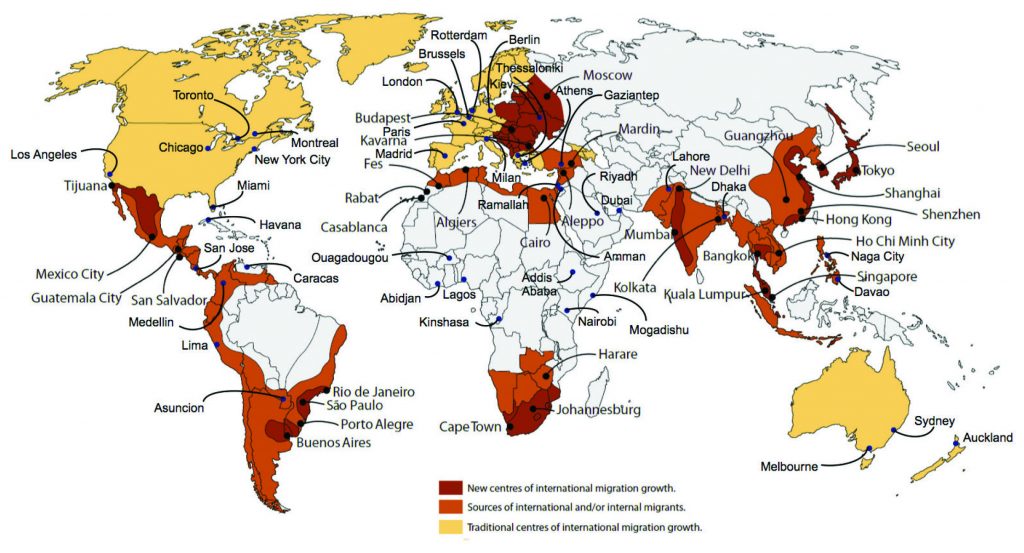
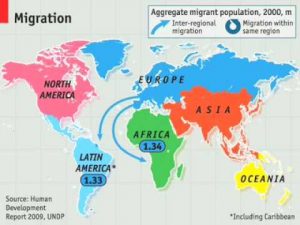
Migration, a permanent move, involves crossing over of the boundary of an administrative unit. When the national boundary of a country is involved, such movements are called international migration. Similarly, if migration takes place within the national boundary of a country, it is termed as internal migration. In the case of international migration the departure of an individual or a group from a country is termed as emigration, while arrival or entry into a country is known as immigration.
The equivalent terms in respect to internal migration are out-migration and in-migration. In fact, each movement is simultaneously emigration (or out-migration) for the place of origin or departure, and immigration (or in-migration) for the place of destination. Gross migration refers to the total number of migrants moving into and moving out of a place, region or country, while net migration is the balance between the number of migrants coming into and moving out of a place, region or country.
In other words, net migration is the gain or loss in the total population of an area as a result of migration. Migration stream is a term used for spatial mobility in which the migrants have a common place of origin and common place of destination.
FACTORS INFLUENCING MIGRATION
A variety of factors can cause migration of individuals. While the factors leading to migration can be classified into several categories, in general term people take decisions to migrate based on push and pull factors.
Push factors are events and conditions that force individuals to move to other locations. They include a variety of motives from the idiosyncratic, such as an individual’s dissatisfaction with the facilities at home, to the dramatic, such as war, economic dislocation, Lack of Job, Poor quality of life, excessive Pollution, Drought and Natural disaster. On the other hand, pull factors are those conditions that attract people to move to a particular new location such as economically, socially and politically stable environment. It is, however, important to note that both push and pull factors operate simultaneously in any migration, though with varying magnitude.
Migration is an international term for movement and its importance cut across societal variables. People tend to escape their problems when they migrate. There is an estimated amount of 244 million people who are currently living outside their country and many of them migrate because of various reasons, such as protection. For some people, migration is a positive and empowering new start, but it is increasingly clear that many humans lack human rights. Migration happens within a country and from country to country. There are a lot of connections when people migrate, for example, jobs; when citizens don’t have a high income, citizens will have a harder time to pay taxes and afford the standard cost of living. Many People migrate due to several reasons and that can include social, political, environmental and economical reason.
In many countries, people do not have the right to speak up or to be different and people with different skin colours are sometimes discriminated. For example: In the early ages, many children were taken away from their families and were put into residential schools, they were not allowed to speak their own language and practice their religion. Many of the children in the residential school suffered and when they returned to their family most of them forgot how to speak their language, so they couldn’t communicate with their family members. Freedom is one of the biggest points people migrate because many people want to be free and have the same rights as everyone. The citizens in North Korea do not have much rights and freedoms. Many people are restricted to leave or come into the country and when citizens speak up to the government, they get severely punished and can also be sent to prison or killed.
Everyone complains about the temperature. Many people like to migrate to places with warmer weather because they won’t have to worry about layers of clothes and winter equipment. Sometimes people are forced to move, this can be in the section under “weather”. Natural disasters tend to destroy lots of homes and that leaves many people homeless. Some of those people stay in a refugee and the others migrate to a new country, to start a new life to rebuild their losses. All these reasons contribute to “weather” and because people can’t stand the cold weather many people move.
Furthermore, migration can be either voluntary or forced. While voluntary migration involves the choice of an individual or a group, forced migration involves a perception of compulsion against the will or choice of concerned individuals. People forced to move are usually compelled by political factors, whereas voluntary migration is usually for economic reasons.
In conclusion, Migration forms the basis of human interaction as people from different race, ethnicity and culture move around for different purposes. The movement of people from one place to another is greatly influenced by economical, political, social and also natural factors like flood, environmental degradation, availability of basic amenities, job opportunities etc. This movement can be internal, external or within the region. Migration has some benefit such as exchange of knowledge and culture, advancement in technology and social interaction.