
- August 8, 2018
- Posted by: admin
- Category: Latest News, Newsletter

There is a troubling pattern around pre-primary school enrolment and funding in Nigeria. Early primary school enrolment in the South West (SW) multiples that in the North East (NE) by as much as almost five times on the average, even though an appreciable number of uneducated children in Nigeria live in the North. That is according to data from the National Bureau of Statistics (NBS). This study centered on pre-primary school enrolment and was conducted by Institutional and Sustainable Development Foundation (ISDF) covering both sexes, the six geopolitical and the years 2003 through 2005.
According to official statistics, the cumulative total number of pre-primary school enrolment across the six geopolitical zones in the three-year period stood at 4,971,408. Of this figure, the entire NE made the lowest contribution. The region made a cumulative contribution of 378,170 in the three-year period, representing 7 per cent. Year on year enrolment in this region was 93,257, 160,068 and 124,845, representing another 7, 9 and 7 percents of enrolment for the years 2003.
Comparing the three years shows that the rate of change for school enrolment stood at 1.7 and 1.3 respectively for 2004 and 2005, whereas the projected growth rate of the economy for these years were somewhere between 6 and 7 percent respectively. The implication is that although pre-primary school enrolment grew, its growth rate was slower than the size of investment in the education sector.
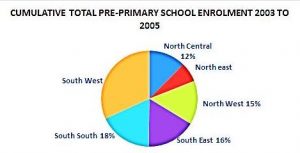
On the other hand, the South West (SW) contributed the highest of 32 per cent to cumulative total enrolment in the three- year period, which is about one-third of cumulative total enrolment and 526, 477 pupils on the average. Interestingly, facts emerging from this region reveal a constant rate of growth of 1.2 per cent for the period, even though the number of pre-school enrolment grow slightly year on year. Other regions captured in the study and their contributions to pre-primary school enrolment included the North Central (12 %), North West (15 %), South East (16%) and South-South (18%).
By implication we are forced to ask: If the growth rate in the education sector is less than those of the entire economy for these periods, how then might we had attained our national growth projections all these years when we consider the role of education, and more specifically pre-primary education, in the sustainable development of a country?
Global trend has switched the emphasis of nations from concentrating on natural resources endowment to the development of human capital achievable through quality education and health care services, which is the bedrock upon which a country like Japan has grown to become a major economic powerhouse in the world.
Upon further investigation of this data by ISDF, fresh pieces of evidence also revealed a disproportion between male and female enrolment year on year in the three-year period across all the geopolitical zones. This revelation is also coming at such a critical time when there is a switch in the perception of women as mere kitchen occupiers with empirical evidence to prove their leadership capacities as drivers of economic emancipation of many countries like Croatia and Germany, and hence the need for gender parity.
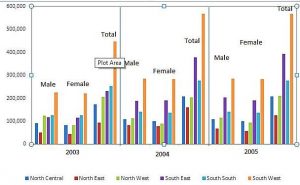 Finally, an infinitesimal increase was recorded in the enrolment patterns of the entire regions for the period under review. This goes to show that for the country to growth, each region must record an appreciable level of pre-primary enrolment more than the rate of illiteracy to be able to combat the growing trend of poverty in the land.
Moses Oshiogwe
Program Officer
ISDFoundation