
- November 20, 2020
- Posted by: admin
- Category: Latest News, Newsletter

Institutional and Sustainable Development Foundation
By Ogwu Paul Okwuchukwu
© November 2020
As a result of the unsustainable nature of the hydrocarbon economy, the effect of the covid 19 and the harmful effects of hydrocarbons towards the economy, we should start thinking of greening and diversifying the Nigerian economy through building a sustainable, productive and environmentally friendly processes of production.
The green economy is defined as economy that aims at making issues of reducing environmental risks and ecological scarcities, and that aims for sustainable development without degrading the environment. It understands the harmful nature of some of our economic practices and production and to adopt a less harmful and alternative means of production that is sustainable and profitable to the country and the environment. This is a low carbon, resource efficient and socially inclusive economy.
The 2011 UNEP Green Economy Report argues “that to be green, an economy must not only be efficient, but also fair. Fairness implies recognizing global and country level equity dimensions, particularly in assuring a Just Transition to an economy that is low-carbon, resource efficient, and socially inclusive.
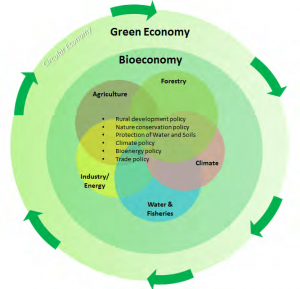
We can achieve these through diversifying the economy through the following sectors Agriculture and forestry, tourism, construction, energy and water.
Agriculture seems to be the commonest form of not only diversifying the economy but also making sure the economy is sustainable through the added value added to the agriculture value chain. From ensuring food security, improvement in health wellbeing, improved employment, establishment of agro based industry and generation of income for all and increase in productivity of the economy. There numerous benefit we get from having an economy that takes agriculture seriously. This is achieved through a conducive environment and the right framework that encourages agriculture. “Greening the Economy with Agriculture (GEA) refers to ensuring the right to adequate food, as well as food and nutrition security – in terms of food availability, access, stability and utilization – and contributing to the quality of rural livelihoods, while efficiently managing natural resources and improving resilience and equity throughout the food supply chain, taking into account countries’ individual circumstances’ .
Added to Agriculture is forestry. The short and long term benefits of forestry cannot be over emphasis. It is estimated that more than 1 billion people globally depends on forestry. Apart from the financial benefits of forestry, the other environmental and other benefits include its use as a recreational and tourism potential and forestry role in climate change, eradication of erosion, flooding and its role in helping soil structure and composition. Forestry can also help in curbing desertification. The other import role of forestry as a means of livelihood for the population in the areas of wood, product for papers, furniture, animal feeds and the energy use in some places. Forestry is a billion-dollar industry that can be harnessed and utilized for the benefit of the country and diversification.
Another area that we can ensure greening the economy through deliberate effort is tourism. Just like forestry can serve as a tourist attraction tourism in itself is a big industry. This can be done by making sure most of our natural resources and lands, parks and forest reserves and other productive ventures are green enough to attract tourist from other countries and within and also helps in creating a sustainable economy that promotes green economy.
One of the most potent tool to help the Nigeria economy is to turn it into a green economy by adopting the sustainable energy platform that include diversified energy resources and the adoption of a cleaner, greener and alternative energy resources. Nigeria is largely dependent on carbon energy as the major source of Nigeria. Nigeria been energy poor can aggressively embark on the alternative forms of energy like wind and Solar that are not only efficient band effective but a potentially revenue generating venture that are not only environmentally friendly and sustainable but lucrative. Green economies require a transition to green energy generation based on renewable energy to replace fossil fuels as well as energy conservation and efficient energy use
There are some conditions which relate to business, intra-industry and collaborative action for a transition towards a green economy. These include Open and competitive market, metrics, accounting, and reporting, Finance and investment, awareness, Life cycle approach, resource efficiency and decoupling, employment, education and skills, Governance and partnership, Integrated policy and decision-making.
The Green Economy provides a macro-economic approach to sustainable economic growth with a central focus on investments, employment and skills. The role of green energy in diversifying our energy source, control of climate change, solving of our energy generation and short fall and also the industrialization of the Nigeria economy cannot be over emphasis. It enhances energy and resource efficiency, and prevention of the loss of biodiversity and ecosystem services.
We need a greening economy that is beneficial to the environment and also a sustainable society.