
- May 29, 2026
- Posted by: admin
- Category: Occasional Papers, Policy Brief
Institutional and Sustainable Development Foundation
Doc9
Policy Brief

| Policy Brief :CRITICAL MINERALS IN NIGERIA: Challenges, recommendations and uses i.e. Energy Transition |
LIST OF ACRONYMS AND ABBREVIATIONS
CDA: Community Development Agreement
CRMs.: Critical Rear Minerals
DRC.: Democratic Republic of Congo
ETPs.: Energy Transition Plan
EU.: European Union
EV, Electric Vehicle
FDI: Foreign Direct Investment
MCO: Mining Cadastral Office (
NDCs: National Determined Contribution
R&D.: Research and Development
REEs: Rear Earth Elements
Institutional and Sustainable Development Foundation (ISDF)
Profile
The Institutional and Sustainable Development Foundation (ISDF) is a non-governmental organization (NGO) based in the Federal Capital Territory (FCT), Nigeria. We are committed to advancing good governance, sustainable development, and social equity through focused work in the following sectors:
Natural Resource Governance
Climate Change and Environmental Justice
Public Sector Accountability
Education and Human Capital Development
ISDF drives change through a combination of evidence-based advocacy, policy engagement, research, and community outreach. Our initiatives aim to influence policies, strengthen institutions, and empower citizens, particularly in resource-rich and underserved communities.
Contact Us
🌐 Website: www.isdfoundation.org.ng
📧 Email: isdf077@gmail.com, info@isdfoundation.org.ng
📞 Phone: +234 810 603 0622,
@ Ogwu Paul okwuchukwu (Author )
@ isdfoundation
Table of Contents
List of Figures 1
List of Tables 3
1.0 overview. 3
2.0 Introduction 4
3.0 Background. 5
4.0 Distribution OF Nigeria S Critical Minerals 5 5.0 Legislative, Regulatory and policy framework guiding mining in Nigeria…………………………….7
6.0 Strategic and Regional implications………………………………………………………………………………………… .8
6.0 Beneficiation ……………………………………………………………………………………………………………………………….9
7.0 Strategic and Regional implications……………………………………………………………………………………………9
8.0 Policy Challenges: There are several policy challenges affecting full maximization of benefits of critical minerals…………………………………………………………………………………………………………………………………….10
9.0 Challenges and Risks affecting the critical mineral sector………………………………………………………. 11
10.0 Policy Recommendations…………………………………………………………………………………………………….12
11.0 Role of Civil Society in the evolving critical minerals in Nigeria………………………………………………….13
12.0 Conclusion…………………………………………………………………………………………………………………………….14
References
Nigeria is at a critical point in its energy transition plan. Critical minerals in Nigeria can power both its own transition such as local battery production, solar manufacturing and global demands for critical minerals. It can also help promote economic diversification away from fossil fuel (which accounts for over 80% of exports as well as other benefits of critical minerals. As the nation works to meet its obligations under the Paris Agreement, which include cutting greenhouse gas (GHG)emissions the energy transition and other climate pledges have a chance thanks to these minerals. The production of batteries, solar panels, wind turbines, electric vehicles (EVs), and grid infrastructure all depend on some critical minerals like (lithium, nickel, cobalt, copper, rare earth elements (REEs), graphite, and others for production.
Critical minerals in Nigeria can boost the domestic use of renewable energy, generate employment, attract foreign direct investment, and position Nigeria as a regional supplier. The country’s energy transition strategy should focus on key minerals such as lithium, cobalt, nickel, and rare earth elements. These minerals offer an avenue to diversify the economy from an oil-based focus and to establish Nigeria as a supplier of renewable energy technologies. However, to realize this potential, the country requires effective administration, legal and policy framework, significant spending on infrastructure, and environmentally responsible mining methods.
Fossil fuels currently dominate Nigeria’s energy industry, accounting for over 62% of the country’s total greenhouse gas emissions. Recent estimates support this figure. Nigeria has committed to an equitable energy transition through its Energy Transition Plan (ETP). This plan aims to both end energy poverty and reach net-zero emissions by 2060. Gas will be used as a transitional fuel, even though the country has significant potential in renewable energy sources like solar, wind, and hydro. Globally, the shift to low-carbon technologies requires large amounts of minerals. According to the IEA, demand for minerals such as nickel, cobalt, copper, lithium (possibly up to 40 times higher by 2040 in some scenarios), and rare earth elements (REEs) will increase sharply. These minerals are crucial for electric vehicles, energy storage, renewable power, and electrification.
2.0 Background
- Before oil was discovered, Nigeria’s mining industry contributed significantly to the country’s GDP through the export of coal, tin, and columbite.
- By 2040, it is anticipated that the world’s need for essential minerals would have tripled to 35 million tons per year. Nigeria is positioned as a strategic supplier because 30% of reserves are in Africa.
- Coal, bitumen, limestone, iron ore, barites, gold, and lead/zinc are given priority in Nigeria’s present mining strategy; lithium and nickel have not yet been fully incorporated into the roadmap. Lithium deposits can be found in Kwara, Ekiti, Ogun, Nasarawa, Plateau, and Kaduna. developing processing facilities (such as the $20 million facility in Kaduna). essential for grid storage and lithium-ion batteries in electric vehicles.
- Nickel: notably in Kaduna (Dogoma area). Used in high-performance batteries.
- Copper: Widespread reserves essential for wiring in renewables and
- REEs and Others: Monazite/xenotime in northern states; tin, coltan (niobium-tantalum), graphite, cobalt (as byproduct), manganese. REEs critical for wind turbine magnets and EV motors.
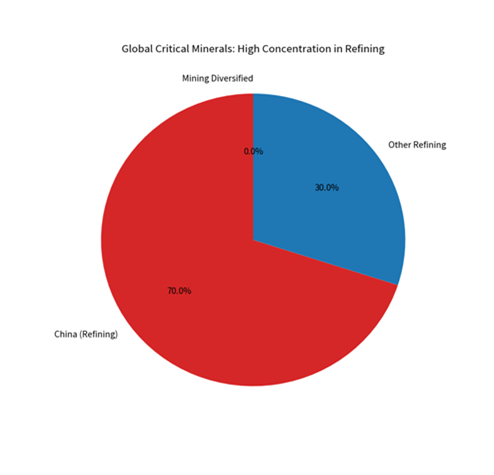
Figure 1 .Global Critical minerals
3.0 DISTRIBUTION OF Nigeria S CRITICAL MINERALS
| Uses in Green and Renewable Technology | ||
| Nickel | Kaduna, Osun, Katsina (and mentions in Kogi, Plateau); substantial reserves reported | Used in battery cathodes (e.g., NMC — nickel manganese cobalt) for higher energy density, longer range in EVs, and stainless steel. Expected to see massive demand growth. |
| Cobalt | Adamawa, Kaduna, Katsina (one of Africa’s higher reserves in some reports). | Stabilizes battery cathodes, improves safety and longevity in lithium-ion batteries for EVs and storage. Also used in some magnets and alloys. |
| Graphite | Kaduna, Adamawa, Niger, Bauchi, Cross River, Jigawa. | Essential for battery anodes (natural or synthetic graphite). Critical for lithium-ion battery performance |
| Copper | Zamfara, Bauchi, Kano, Yobe, Nasarawa, Plateau, others. Nigeria exports raw copper. | Wiring, cabling, transformers, motors, and EV components; excellent conductor for solar/wind power systems and electricity networks. |
| Manganese | Niger, Edo, Adamawa, Kebbi, Borno, Cross River, Kaduna, Zamfara, Katsina | Battery cathodes (e.g., in NMC or LMO batteries); improves stability and capacity. Also used in steel for wind turbine towers |
| Rare Earth Elements (REEs): | Occurrences identified (e.g., in Jos Plateau region with coltan/tin); processing facilities planned. | Elements (e.g., neodymium, dysprosium): Permanent magnets for high-efficiency EV motors and wind turbine generators (especially direct-drive turbines). Enable stronger, lighter magnets |
| Others | Tin and coltan (columbite-tantalite, source of tantalum/niobium) especially in Jos Plateau; zinc; potential platinum group metals. | Solder in electronics, solar panels, and battery tech; associated minerals like tantalum/niobium for capacitors and alloys |
| Lithium | in Kwara, Ekiti, Ogun, Nasarawa, Plateau, Kaduna. Processing plants emerging (e.g., $20M facility in Kaduna). Vital for lithium-ion batteries in EVs and grid storage | Key for lithium-ion batteries in EVs, smartphones, and grid-scale energy storage. Enables high energy density and longer battery life. |
| Zinc: | Galvanizing for infrastructure, batteries, and alloys supporting renewable systems. |
Table 1 Distribution of Nigeria s critical minerals
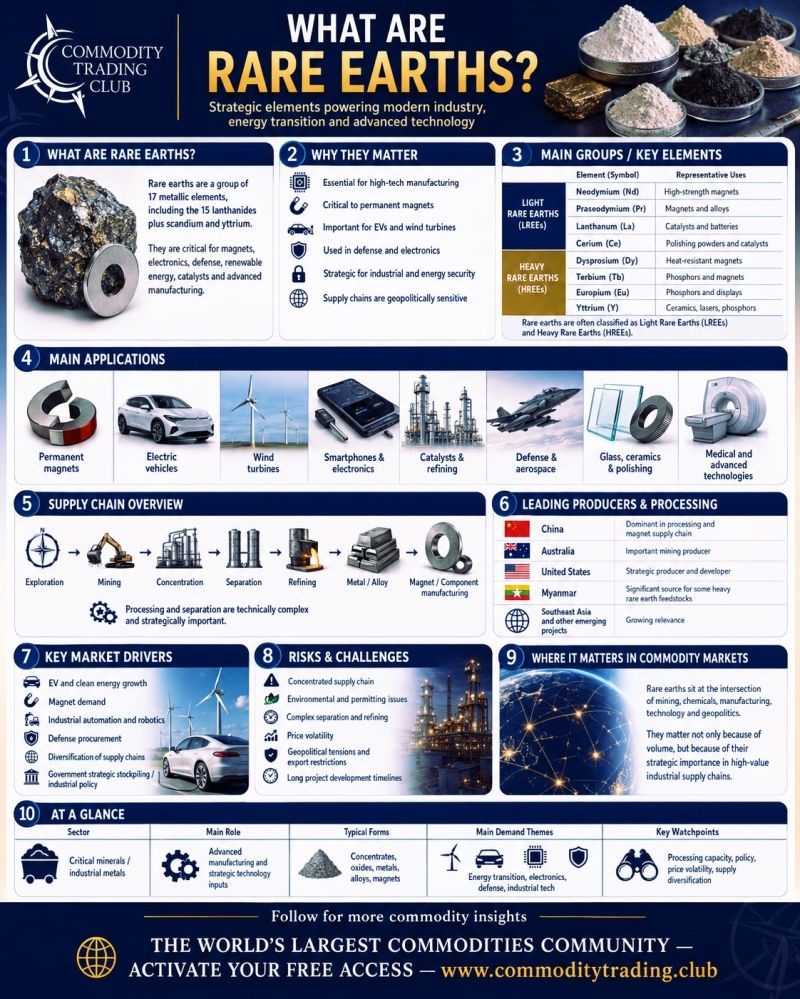
Figure 2 Rare Earth minerals( copied)
4.0 Legislative, Regulatory and policy framework guiding mining in Nigeria
- Nigerian Minerals and Mining Act 2007: The main law. It vests ownership of all minerals in the Federal Government and lays out who can get rights to explore/mine.
- Nigerian Minerals and Mining Regulations 2011: Breaks down the Act into procedures, fees, royalties, environmental rules, and license categories.
- Federal Government is pushing for *local value addition. New bills require 30% processing/beneficiation in Nigeria before export.
- Ministry of Solid Minerals Development*: Policy and oversight.
- Mining Cadastral Office (MCO)*: Issues all mineral titles and runs the cadaster register.
- Mines Inspectorate Department*: Safety, compliance, inspections.
- Mines Environmental Compliance Department + Federal Ministry of Environment*: EIA and environmental compliance.
- MIREMCO: State-level committee for community/mining issues.
- Reconnaissance Permit: For preliminary surveys. 1 year, renewable.
- Exploration License: For detailed exploration. 3 years, renewable twice for 2 years each.
- Small Scale Mining Lease: For low-capital operations. 5 years, renewable.
- Mining Lease: For large commercial mining. 25 years, renewable every 24 years.
- Quarry Lease: For sand, granite, limestone. 5 years, renewable.
- License to Purchase and Possess Minerals: If you’re trading/storing minerals, not mining them.
- Mineral Export Permit: Required for every shipment out of Nigeria.
- Irrevocable consent from landowners/occupiers, sworn affidavit.
- Community Development Agreement* for mining leases.
- Environmental Impact Assessment approved by the Federal Ministry of Environment.
- – Mine rehabilitation and closure plan.
5.0 Strategic and Regional implications
36 nations in Africa generate at least one mineral, and the continent produces 23 CRMs. The Democratic Republic of the Congo (DRC) produces about 74% of the world’s cobalt. The least produced minerals are PGMs, which are produced by South Africa and Zimbabwe, and arsenic and vanadium, which are produced by Morocco and South Africa, respectively. While South Africa, Gabon, and Ghana together produce more than 60% of the world’s manganese, it contains around half of the world’s proven reserves. The majority of CRMs from Africa are shipped unprocessed. Concentrated supply chains, such as those in China for processing and the Democratic Republic of the Congo for cobalt, present prospects for emerging producers like Nigeria, as well as other African nations. In addition, the increasing resource nationalism and scramble for supply chain between the US, China and other EU countries provides an opportunity for Nigeria for strategic partnership and investment.
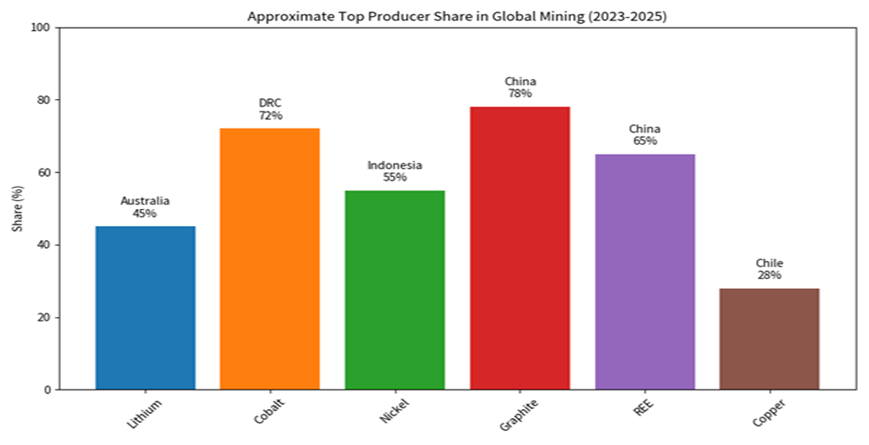
Figure 3
6.0
Sectoral Applications in Nigeria’s Transition:
- Power Sector: Copper and silicon for solar PV; REEs and copper for wind; minerals for storage to address intermittency and diesel generator reliance.
- Transport: Lithium, nickel, cobalt for EVs to decarbonize road transport
- Industry & Storage: Support green hydrogen, efficient manufacturing, and grid stability.
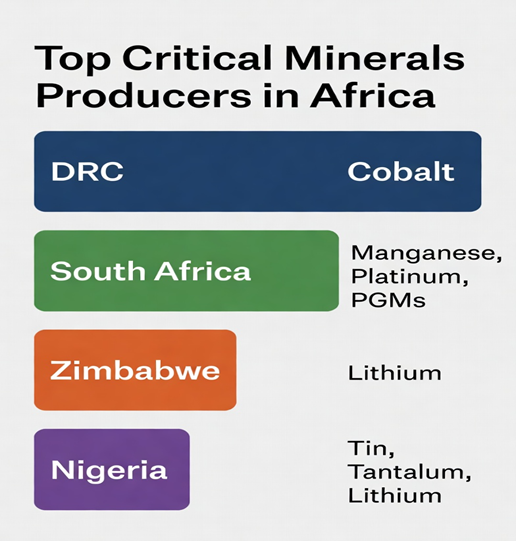
Figure 4
6.0. Importance of Critical Minerals for Nigeria’s Energy Transition.
- Economic Diversification: By reducing the nation’s reliance on oil earnings, critical minerals will stabilize foreign exchange earnings. Additionally, diversifying the economy.
- It will also promote industrial development, which will facilitate the production of batteries, solar panels, and EV components locally.
- Critical minerals are currently a geopolitical and strategicLeverage: Establishes Nigeria as a supplier in international supply chains for renewable energy in a world
where major economies are vying for control of the value chain.
- Beneficiation and the value chain will increase employment: the mining and processing sectors have the potential to create thousands of skilled
jobs as well as other related positions.
- Critical minerals will support Nigeria’s commitment to attain net-zero emissions by 2060 and help the country accomplish its climate goal
7.1 Beneficiation
Beneficiation for critical minerals, including such as crushing, grinding, flotation, gravity separation, magnetic separation, or chemical leaching) that enhance the quality or concentration of ore by eliminating impurities, isolating valuable minerals, or getting them ready for more processing across the value chain. In order to assist economic diversification, job growth, and the global energy transition, shifting from raw ore exports to higher-value domestic processing is a significant policy for Nigeria’s important mineral. Nigeria is expanding its capabilities, frequently in collaboration with Chinese or other international partners, to add value to the raw critical minerals Lithium. Several facilities are either proposed or in operation. Examples include facilities in Nasarawa State (e.g., Avatar New Energy Materials, a facility in Kaduna State (Kangimi/Kangam, partnered with Chinese firm Ming Xin), and others close to Abuja and the Kaduna-Niger border.
.
8.0. Policy Challenges: There are several policy challenges affecting full maximization of benefits of critical minerals.
- Facilities Deficit: Mineral development is restricted by inadequate energy and transportation facilities.
- Weak Governance: Investor confidence is weakened by corruption and ineffective regulations.
- Environmental Risks: Communities and ecosystems may be harmed by unsustainable mining.
- Limited Local Capacity: There is a skills deficit in clean-tech manufacturing, metallurgy, and geology
9.0 Challenges and Risks affecting the critical mineral sector.
- Poor geological mapping, reliable data and low investment, hinder investor confidence. Data and Exploration and the perennial underdevelopment in the solid mineral sector
- Infrastructure and Capacity for effective exploration and beneficiation: Weak roads, power, skills; limited midstream/downstream facilities.
- Poor Governance, effective regulatory supervision, informality and Illegal and harmful operations in the sector: Artisanal mining, insecurity, corruption, license speculation.
- Environmental and Social: Pollution, deforestation, community displacement, child labor risks and other Just transition issues will undermine the sector.
- Policy inadequacy, fragmentation and outdated frameworks: Nigerian Minerals and Mining Act 2007 and related policies exist, but lack critical minerals framework, strong ESG enforcement, or value-addition mandates. These are hindering the full development of the sector
- Create a Critical Minerals Strategy and revise the Mining Roadmap to provide priority to the nation’s most important minerals, such as rare earths, cobalt, nickel, and lithium. Establish precise frameworks for export, beneficiation, and exploration in addition to integrating with NDCs and ETPs. Incorporate value chain mapping, a specialised agency or budget, and goals for domestic processing (e.g., prohibit raw exports of important minerals over time).
- To improve the vital mineral and aid in the sector’s domestication, invest in energy and infrastructure. This is accomplished by building more rail and port facilities for the transportation of minerals, as well as other infrastructures to grow the industry, such as power mining operations that use renewable energy to lower carbon emissions.
- Promote Local Value Addition: Incentives (tax breaks, infrastructure) for processing/refining/battery manufacturing. Establish industrial parks and skills programs in partnership with universities and firms.
- Just Transition Measures: Reskill oil/gas workers; prioritise local content; link mining royalties to renewable projects and social services in host communities.
- Encourage the ease of doing business and make deliberate efforts to attract investment and partnerships: Sovereign wealth/mining fund; attract FDI with clear, stable rules; strategic deals and technology transfer. Explore recycling and substitution R&D.
- To establish local value chains and domestication, promote domestic manufacturing of batteries and solar panels. One approach to do this is to form partnerships for technology transfer with foreign companies.
- Improve governance, enforcement, compliance, and transparency in the crucial mining sector. Adopt international best practices for mineral traceability and implement anti-corruption policies in licensing and revenue management.
- Supporting community development programs in mining areas and promoting sustainable mining by adhering to environmental impact assessments are essential.
- Expand Data and Exploration: Public-private geological mapping, open data portals, and more funding for the Nigerian Geological Survey Agency. This will attract investors to the sector
11. 0 Role of Civil Society in the evolving critical minerals in Nigeria
Nigeria’s civil society has a role in the critical minerals chain in Nigeria, especially in ensuring accountability, community inclusion, responsible and sustainable mining and just transition.
- Policy advocacy and road map intervention
- Community inclusion and conflict prevention and participation especial on the community development agreement
- Transparency, anti-corruption oversight
- Promoting sustainability, responsible sourcing and local beneficiation
- Ensuring the implementation of Just Transition.
12.0. Conclusion
Nigeria’s critical minerals are a strategic asset for its energy transition, offering economic diversification, industrial growth, and climate resilience. To harness this potential, Nigeria must shift from extractive dependence to value-added production, ensuring that critical minerals become a cornerstone of its post-oil economy. Nigeria’s vital minerals are more than just resources; they support the country’s energy transformation and transition, economic stability, economic diversification and ability to compete internationally. Nigeria can lower emissions, generate wealth, and spearhead Africa’s green industrialisation by transitioning from raw extraction to a sustainable, industrialised value chain. The window is open, and Nigeria’s success in the global energy revolution will depend on how strategically it moves forward.
References:
Africa Policy Research Institute.https://afripoli.org/developing-nigerias-critical-minerals-industry-to-support-global-energy-transition
African Development Bank. (2023). Rich in green minerals, African countries eye booming electric vehicle and clean energy market worth trillions of dollars. https://www.afdb.org/en/news-and-events/rich-green-minerals-african-countries-eye-booming.
BusinessDay. (2024, July 31). Tinubu welcomes Nigeria’s largest lithium plant. https://businessday.ng/news/article/tinubu-wel
Case for critical minerals legal and policy reform in Nigeria, https://guardian.ng/opinion/case-for-critical-minerals-legal-and-policy-reform-in-nigeria/ 2021.pdf?rev=e4a9bdcb93614c6c8087024270a2871d
Center for Sustainable Systems, University of Michigan. 2024. “Critical Materials Factsheet.” Pub. No. CSS14-15. https://css.umich.edu/publications/factsheets/material-resources/critical-materials-factsheet
Collins Okeke, Gukongozi Ugwuezi ,The Case for Critical Minerals Legal and Policy Reform in Nigeria https://oal.law/the-case-for-critical-minerals-legal-and-policy-reform-in-nigeria/
How can Africa make the most of its transition minerals? A pledge for enhancing value addition for development and prosperity ( pwyp.org) September 2024 https://pwyp.org/wp-content/uploads/2024/09/PWYP-Transition-Minerals-briefing-EN.pdf
https://resourcegovernance.org/articles/how-fight-corruption-transition-mineral-producing-countries-must-meeting-climate-and https://resourcegovernance.org/articles/power-people-perspectives-nigerias-energy-transition-plan
https://www.irena.org/-/media/Irena/Files/Technical-papers/IRENA_Critical_Materials_
IEA (2021) The Role of Critical World Energy Outlook Special Report Minerals in Clean Energy Transitions. https://iea.blob.core.windows.net/assets/ffd2a83b-8c30-4e9d-980a-52b6d9a86fdc/TheRoleofCriticalMineralsinCleanEnergyTransitions.pdf.
International Energy Agency. (2021). The Role of Critical Minerals in Clean Energy Transitions. https://www.iea.org/reports/critical-minerals-market-review-2023/key-market-trends#abstract.
International Energy Agency. (2023). Critical Minerals Market Review 2023. IEA. https://www.iea.org/reports/critical-minerals-market-review-2023
Oluwatola, T. (2025). Developing Nigeria’s critical minerals industry to support the global energy transition (Policy paper).