
- August 8, 2018
- Posted by: admin
- Category: Latest News, Newsletter

Climate change has contributed to the massive migration of herdsmen to the middle belt and southern regions of Nigeria. The change in climate such as depletion in the ozone layer has led to heat waves, dryness of the rivers and lack of pasture for cattle to graze amongst others and has made life uncomfortable for the people and animals. This has resulted in the migration to safer areas. The shrinking of Lake Chad from 45,000km2 to 3000km2 in less than three decades compounds the emerging conflict further. The consequence, according to the United Nations, is the displacement of about 10.5 million people.
Global warming is impacting us, and Nigeria is vulnerable in many different ways. Our resources are dwindling because of desertification in the North, and ocean surge and erosion in the Southern regions. Purchasing power and natural resources are fast depleting while at the same time our population is growing exponentially. This has added a lot of pressure to the already fractured fault lines in the country.
|
S/N |
STATE | TOTAL DEATH TOLL |
| 1 | ADAMAWA | 67 |
| 2 | BENUE | 275 |
| 3 | KADUNA | 75 |
| 4 | KOGI | 48 |
| 5 | KWARA | 54 |
| 6 | NASARAWA | 129 |
| 7 | NIGER | 1 |
| 8 | PLATEAU | 87 |
| 9 | TARABA | 180 |
| Cumulative Total | 916 |
NB: From January 2018 to July 2018 the Death toll has risen to over 1,750
Although for some Nigerians, there are other reasons for the clash which goes beyond economic and ecological reasons. Climate change is not ranked among the five top causes of conflict in Nigeria, namely, Tribalism, Resource Control, Religion, Land and Trade. But Nigeria has not been affected by any situation since the civil war like the effect of the Farmer Herdsman clash. In the wake of the rising attacks, two states of Benue and Taraba have enacted Anti-grazing laws that make grazing in open field or farm a punishable offence. These have rather worsened the conflict instead of minimizing it.
The number of deaths as a result of the farmer and headsman clash.
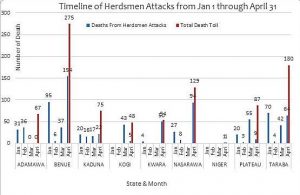
Info graphic by Oshiogwe Moses Asenokha
The conflict situation has defiled any major categorization as it covers a variety of theories of conflict. The conflict can be situated in the communities’ relations theory, identity theory and intercultural miscommunication theory. The conflict in its interpretation and conspiracy theories has resulted in the conflict being intractable.
Although the government has instituted several committees to resolve these intractable conflicts, it has failed to muster the political will to implement some of the recommendations of these inquiries because of the social, political, ethnic and other consideration. It is difficult to have a citizen buy-in because of the prevailing mistrust among the farmers and herdsmen and also a long held ethnic and religious mistrust.
Some of the findings from the government about Farmer/herdsmen conflicts can be found in various reports of the committees set up by the government: there was the presidential peace initiative committee in 2002, the Federal Administrative Panel of Inquiry in 2008, the Federal Advisory Committee in 2010, post advisory committees on security challenges in 2012 and so many others.
For a reduction in these crises, the government needs to sort out the following;
- The Federal Government should as a matter of urgency review our border patrol system, thereby providing more security personnel, deployment of new technological facilities that will aid the immigration and tracking of the herdsman.
- The ECOWAS Trans-human Protocol of 1998 and the ECOWAS Protocol on Free Movement of Goods and Persons in West Africa also needs to be reviewed. Both acts allow herders access to designated stock routes and grazing lands/reserves through the West African countries. The review should be put in place to ensure efficiency and to identify new routes as some of those already identified routes have been turned to farmlands.
- Another viable way of keeping the crisis minimal is creating and revitalizing grazing reserves, especially within states in the North that have already indicated interest in doing so. Over the years, the victims of these clashes have been shoved aside, with no form of compensation for the lives and properties lost.
The country is in the verge of witnessing a major food crisis, ethnic war and political uprising if the various measures are not put in place to tackle this crisis.
Paul Ogwu