
- November 20, 2020
- Posted by: admin
- Category: Latest News, Newsletter

Ernest Oji,
Environmentalist, University of Jos, Nigeria.
@November 2020
As described in various renowned journals of sciences, Global warming is the term used to describe a gradual increase in the average temperature of the Earth’s atmosphere and its oceans, a change that is believed to be permanently changing the Earth’s climate. There is great debate among many people, and sometimes in the news, on whether global warming is real (some call it a hoax) but climate scientists looking at the data and facts agree the planet is warming. While many view the effects of global warming to be more substantial and more rapidly occurring than others do, the scientific consensus on climatic changes related to global warming is that the average temperature of the Earth has risen between 0.4 and 0.8 °C over the past 100 years. The increased volumes of carbon dioxide and other greenhouse gases released by the burning of fossil fuels, land clearing, agriculture, and other human activities, are believed to be the primary sources of the global warming that has occurred over the past 50 years. Scientists from the Intergovernmental Panel on Climate carrying out global warming research have recently predicted that average global temperatures could increase between 1.4 and 5.8 °C by the year 2100. Changes resulting from global warming may include rising sea levels due to the melting of the polar ice caps, as well as an increase in occurrence and severity of storms and other severe weather events.
The Consequences of a Warming World
Over the last century, global average temperature has increased by more than 1°F (0.7°C). This warming has been accompanied by a decrease in very cold days and nights and an increase in extremely hot days and warm nights.
Of course, land and ocean temperature is only one way to measure the effects of climate change. A warming world also has the potential to change rainfall and snow patterns, increase droughts and severe storms, reduce lake ice cover, melt glaciers, increase sea levels, and change plant and animal behaviour.
Some Solutions to global warming
- Boosting energy efficiency: The energy used to power, heat, and cool our homes, businesses, and industries is the single largest contributor to global warming. Energy efficiency technologies allow us to use less energy to get the same or higher level of production, service, and comfort. This approach has vast potential to save both energy and money, and can be deployed quickly.
- Greening transportation: The transportation sector’s emissions have increased at a faster rate than any other energy-using sector over the past decade. A variety of solutions are at hand, including improving efficiency (miles per gallon) in all modes of transport, switching to low-carbon fuels, and reducing vehicle miles travelled through smart growth and more efficient mass transportation systems such as railway transportation system.
- Reviving up renewables: Renewable energy sources such as solar, wind, geothermal and bioenergy are available around the world. Multiple studies have shown that renewable energy has the technical potential to meet the vast majority of our energy needs. Renewable technologies can be deployed quickly, are increasingly cost-effective, and create jobs while reducing pollution.
- Phasing out fossil fuel electricity: Dramatically reducing our use of fossil fuels, especially carbon-intensive coal is essential to tackle climate change. There are many ways to begin this process. Key action steps include: not building any new coal-burning power plants, initiating a phased shutdown of coal plants starting with the oldest and dirtiest, and capturing and storing carbon emissions from power plants. While it may sound like science fiction, the technology exists to store carbon emissions underground. The technology has not been deployed on a large scale or proven to be safe and permanent, but it has been demonstrated in other contexts such as oil and natural gas recovery. Demonstration projects to test the viability and costs of this technology for power plant emissions are worth pursuing.
- Managing forests and agriculture: Taken together, tropical deforestation and emissions from agriculture represent nearly 30 percent of the world’s heat-trapping emissions. We can fight global warming by reducing emissions from deforestation and forest degradation and by making our food production practices more sustainable.
- Exploring nuclear: Because nuclear power results in few global warming emissions, an increased share of nuclear power in the energy mix could help reduce global warming but nuclear technology poses serious threats to our security and, as the accident at the Fukushima Diaichi plant in Japan illustrates to our health and the environment as well. The question remains: can the safety, proliferation, waste disposal, and cost barriers of nuclear power be overcome?
- Developing and deploying new low-carbon and zero-carbon technologies: Research into and development of the next generation of low-carbon technologies will be critical to deep mid-century reductions in global emissions. Current research on battery technology, new materials for solar cells, harnessing energy from novel sources like bacteria and algae, and other innovative areas could provide important breakthroughs.
- Ensuring sustainable development: The countries of the world from the most to the least developed vary dramatically in their contributions to the problem of climate change and in their responsibilities and capacities to confront it. A successful global compact on climate change must include financial assistance from richer countries to poorer countries to help make the transition to low-carbon development pathways and to help adapt to the impacts of climate change.
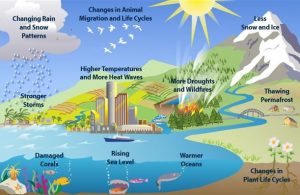
The impacts of a warming world are already being felt by people around the globe. If climate change continues unchecked, these impacts are almost certain to get worse. From sea level rise to heat waves, from extreme weather to disease outbreaks, each unique challenge requires locally-suitable solutions to prepare for and respond to the impacts of global warming. Unfortunately, those who will be hit hardest and first by the impacts of a changing climate are likely to be the poor and vulnerable, especially those in the least developed countries. Developed countries must take a leadership role in providing financial and technical help for adaptation.
Reference
www.livescience.com/topics/global–warming
www.climatehotmap.org/about/global–warming-causes.html
Other Important articles supporting climate change.
https://www.itu.int/en/myitu/News/2020/10/27/08/22/Green-economy-UAE-theory-practice-ICTs
https://iloblog.org/2020/10/12/a-better-future-of-work-means-building-it-green/